
Subterranean vs. Drywood Termites: What Alabama Homeowners Need to Know
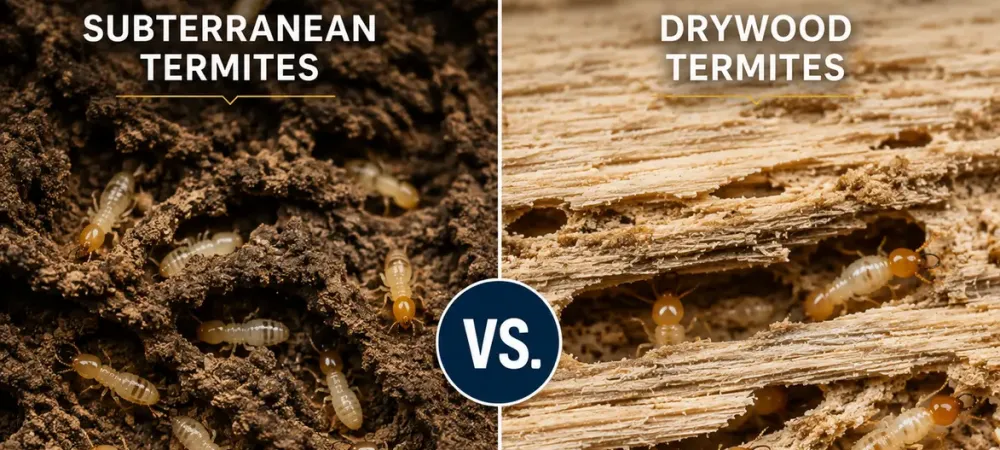
Subterranean termites are the dominant termite threat across Alabama, while drywood termites are present in the state too but concentrated mainly in southern counties and far less common overall. Knowing which one you're actually dealing with matters, because the two behave so differently that a treatment built for one usually won't touch the other. Here's what separates them, and why checking for the wrong sign can leave a real infestation undetected.
Quick answer: Subterranean termites live underground and travel to wood through mud tubes, while drywood termites live entirely inside the wood they're eating and never touch soil. In most of Alabama, including Lee and Chambers counties, subterranean termites are the far more likely culprit.
In This Article
Which Termites Are Actually in Alabama
Eastern subterranean termites are found statewide and cause the majority of termite damage in Alabama homes. Formosan termites, a more aggressive subterranean species, have also been documented in several counties including Lee County, part of our core service area. Drywood termites exist in Alabama as well, but they're concentrated mainly in the southern part of the state and show up far less frequently than either subterranean species in most inland areas.
How Subterranean Termites Behave
Subterranean termites live underground and build mud tubes to travel between the soil and the wood they're feeding on, since they need constant contact with moisture to survive. A single colony can hold hundreds of thousands of termites, and Formosan colonies specifically can grow even larger, feeding around the clock rather than in short bursts. According to the Alabama Cooperative Extension System, termites are drawn to two things above all else, water and cellulose, which is why moisture control around a foundation does real work in reducing the risk.
How Drywood Termites Behave
Drywood termites live entirely inside the wood they're eating and never need soil contact at all, pulling the moisture they need directly from the wood itself. Their colonies are far smaller, typically numbering in the thousands rather than hundreds of thousands, and they tend to settle into furniture, attic framing, and other structural wood rather than spreading through an entire yard. Because they don't need soil, a drywood infestation can sit undetected in an isolated piece of wood for a long time before anyone notices.
The Mud Tube Myth
Checking only for mud tubes and assuming there's no termite problem if you don't find any is a mistake, because drywood termites never build them in the first place. The real signs of a drywood infestation are frass, small pellet-shaped droppings, and tiny kick-out holes in the wood where those pellets get pushed out. Someone looking exclusively for mud tubes along a foundation could walk right past an active drywood infestation in a piece of furniture or attic framing.
Subterranean vs. Drywood Termites at a Glance
| Factor | Subterranean | Drywood |
|---|---|---|
| Habitat | Underground colony, travels via mud tubes | Lives entirely inside the wood it's eating |
| Colony size | Hundreds of thousands or more | Typically a few thousand |
| Signs of infestation | Mud tubes, wood damage, swarmers | Frass (pellet droppings), kick-out holes |
| Moisture needs | Requires soil contact and moisture | Draws moisture from the wood itself |
| Prevalence in Alabama | Dominant species statewide | Present, concentrated in southern counties |
Why It Matters for Treatment
Treatment approach depends heavily on which type is actually present, since a bait system built to intercept a soil-based colony won't do much against termites that never touch the ground. Subterranean termites respond well to bait systems and liquid soil treatments because both rely on the colony's connection to the ground. Drywood termites need a treatment aimed directly at the infested wood, since there's no soil-based colony to intercept in the first place.
When to Call a Professional
Correct identification is what determines the right treatment plan, so a professional inspection matters more here than guessing based on one sign alone. A licensed inspection can confirm which species is present and rule out the other, which saves you from paying for a treatment method that was never going to reach the actual infestation.
Not Sure Which Termite You're Dealing With?
Not sure what's actually causing the damage, or just want to rule it out? Call Envirogreen at 334-246-3131 and we'll help you figure out the right next step.
Sources: Alabama Cooperative Extension System, "Termite Territory is Expanding in Alabama," aces.edu/blog/topics/home/termite-territory-is-expanding-in-alabama-the-basics-of-termite-control/.