
Quick Answer
The brown recluse is one of the few spiders in Alabama that poses a real health concern, and it has been found throughout the state. True to its name, it is shy and spends the day hidden in dark, undisturbed spots like closets, storage boxes, and crawl spaces. Brown recluses rarely bite, and most bites happen when a spider gets trapped against skin in clothing, shoes, or bedding.
Identification
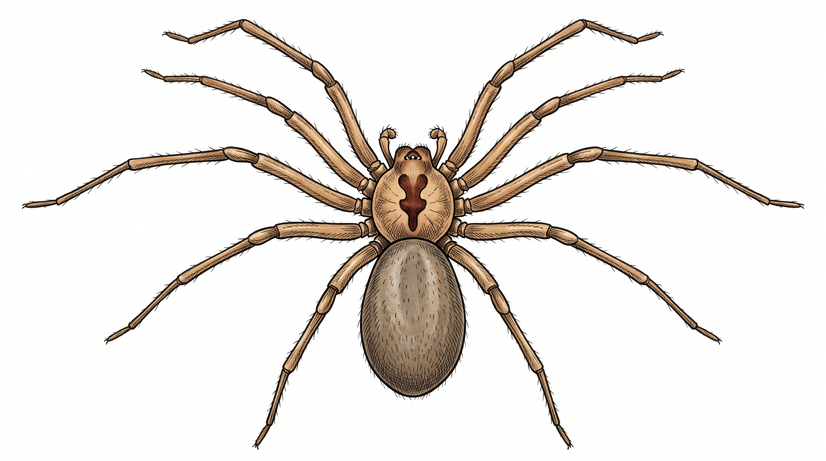
Brown recluses are pale tan to brown with smooth, evenly colored legs. Female bodies measure about ¼ to ½ inch, with a leg span over 1 inch. Their best-known feature is a dark violin-shaped marking behind the head, but the marking can vary, so the eye pattern is the more reliable way to confirm one.
| Spider | Eye Pattern |
|---|---|
| Brown recluse | Six eyes arranged in three pairs, forming a semicircle with gaps between each pair |
| Sac and funnel weaver spiders | Eight eyes arranged in two rows of four |
| Cellar spiders | Eight eyes closely grouped, or six eyes in two clusters |
Signs Of Infestation
Brown recluses leave molted skins stretched flat against surfaces, often on the sides of stored boxes.
Instead of webs for catching prey, they build small, irregular silk retreats in corners, boxes, and undisturbed spaces.
Sticky, silken sacs less than an inch across. A single female can produce several sacs in one summer.
Brown recluses usually come out at night. Seeing them on floors or walls during the day can point to crowding or disturbance.
Risks And Damage
Brown recluse bites are rare and usually happen in self-defense, when someone rolls onto a spider in bed, puts on clothes or shoes, or moves stored items. The bite is often painless at first, but the venom can cause a sore that is slow to heal. Most bites stay localized and heal within about three weeks, though some develop into an open wound that takes months to heal. In rare cases, especially in children and older adults, a bite can cause fever, dizziness, nausea, or other whole-body symptoms.
If you think you've been bitten, see a doctor promptly. If you can safely capture the spider, bring it with you. Even a crushed spider can usually be identified, which helps your doctor choose the right treatment.
Prevention Tips
- Declutter closets, storage rooms, and other areas where spiders can hide undisturbed
- Shake out shoes, clothing, and bedding that have been sitting unused
- Remove bed skirts and keep bedding off the floor to reduce the chance of spiders reaching the bed
- Seal cracks around windowsills, door thresholds, pipes, and vents
- Improve ventilation in attics and crawl spaces
- Move woodpiles, leaf litter, and rocks away from the house
- Vacuum up spiders and webs, then dispose of the vacuum bag outside